

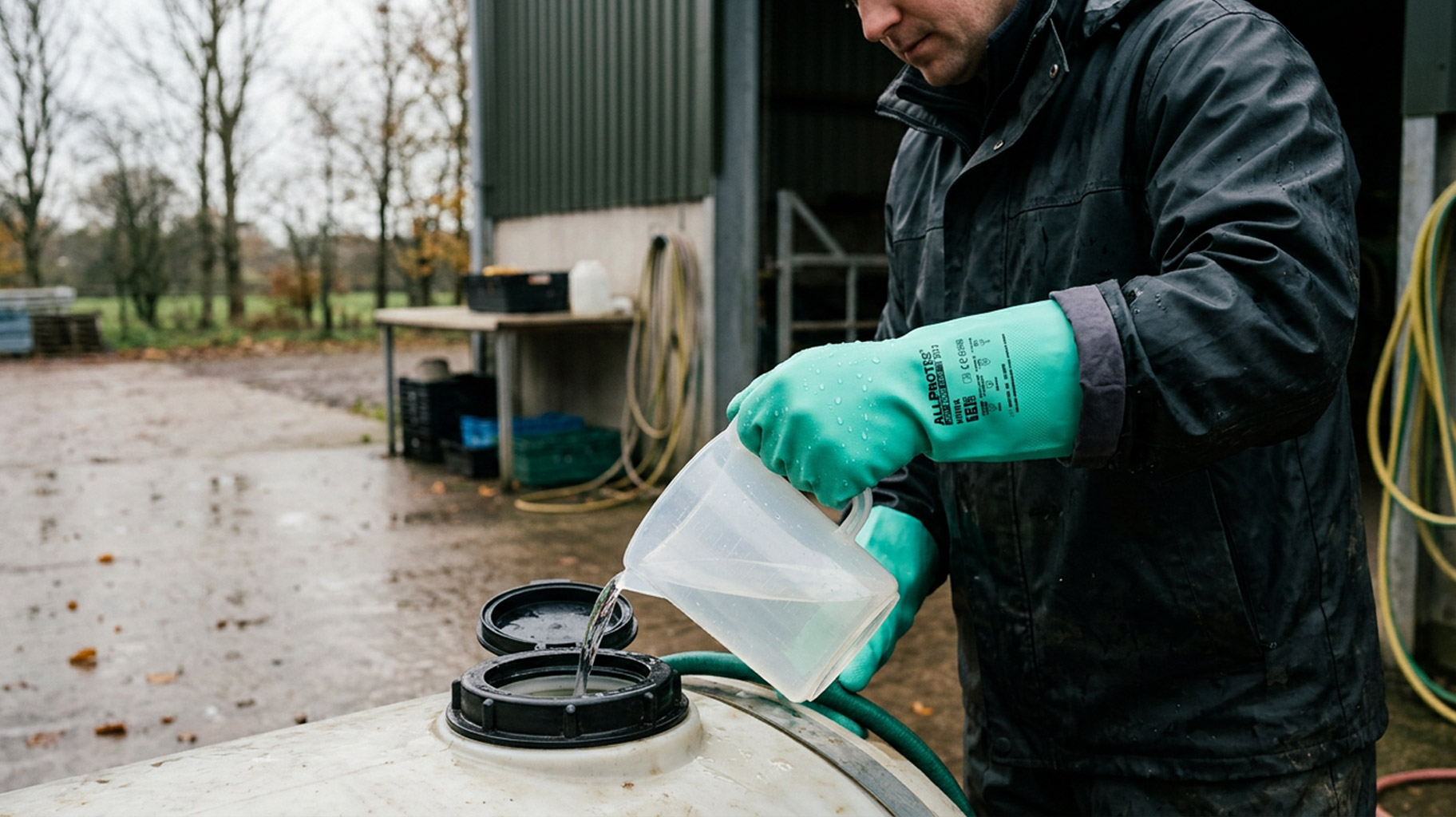

Anyone who works regularly with plant protection products knows the situation: there are several standard abbreviations on the glove, the container says "wear suitable protective gloves" – and in between it remains unclear which glove actually fits which activity. For exactly this gap, there has been a separate standard for a few years: ISO 18889:2019. This article explains what is behind the standard, how classes G1 and G2 differ, and what else to look out for when choosing a suitable glove.
What is ISO 18889:2019?
ISO 18889:2019 describes requirements for protective gloves worn when handling plant protection products. It is not a general chemical protection standard, but a supplement tailored to the special conditions in plant protection: handling diluted and concentrated agents, the typical work steps, and the mechanical stress that occurs.
The result of the testing is a classification into a performance class. It appears on the glove as the marking G1 or G2 together with the standard designation ISO 18889:2019. This marking is the focal point of the article – the following text refers consistently to the currently valid 2019 version.
Why does this standard exist in addition to EN ISO 374?
EN ISO 374-1 is the basis for every chemical protective glove. It tests the glove material against a specified list of test chemicals and determines how long it can withstand the respective substance before it penetrates the material (permeation). The result is a classification as Type A, B, or C, along with the letter codes for the passed test chemicals.
However, plant protection products are generally not pure substances, but formulations: one or more active ingredients combined with solvents, wetting agents, and other adjuvants. Classical chemical testing only indirectly reflects this area of application. This is where ISO 18889:2019 comes in: it complements chemical testing specifically for the handling of plant protection products.
For the evaluation of permeation, no single commercial product is used, but a so-called pesticide surrogate – a defined substitute substance that represents typical plant protection products and enables reproducible test results. This allows gloves to be compared uniformly without having to test every product available on the market individually. At the same time, this means: the classification indicates fundamental suitability in plant protection, not the behavior towards a specific preparation.
>> ALLPROTEC® NITRIX WITH 31.8% DISCOUNT <<

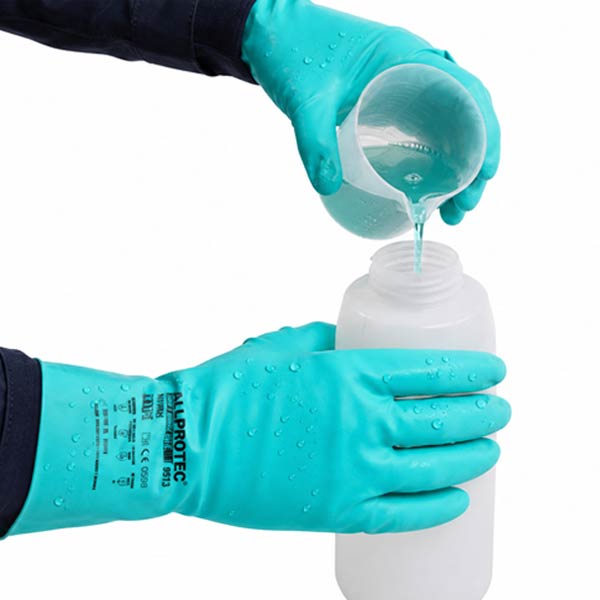
G1 and G2 – what the classes mean
ISO 18889:2019 distinguishes between two performance classes. They represent different levels of protection – not simply "diluted" versus "concentrated".
G1 is intended for applications with lower risk. Gloves of this class are not suitable for handling concentrated plant protection products.
G2 offers a higher level of protection. Gloves of this class are suitable for both diluted and concentrated plant protection products. In addition, G2 includes minimum requirements for mechanical resistance alongside chemical protection requirements – such as abrasion and tear resistance, as required when handling containers, closures, and fittings.
| Feature | G1 | G2 |
| Intended risk level | lower | higher |
| Diluted plant protection products | suitable | suitable |
| Concentrated plant protection products | not suitable | suitable |
| Minimum requirements for mechanical resistance | – | yes |
One important limitation applies here: A G2 rating does not automatically mean that the glove covers all activities involving plant protection products or the entire work process. It describes the tested protection level—suitability for the specific activity and specific product must be evaluated separately.
When is G2 relevant?
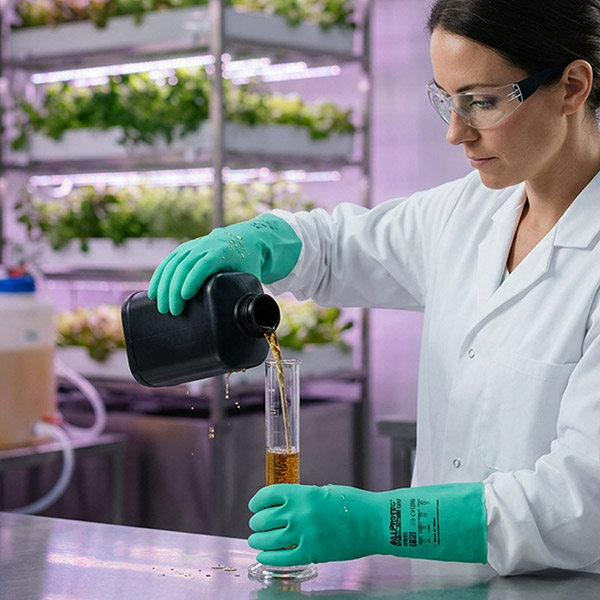
In the work process, there are activities where direct contact with concentrated plant protection products is possible: in particular when preparing the spray mixture, when mixing and when filling - i.e., when opening containers, measuring, decanting, and handling remaining quantities. For these activities, the G2 classification is particularly relevant because only it covers the handling of concentrated agents.
How high the actual exposure is depends on the product, the working method, and the technology used. A general ranking of the work steps cannot be derived from this. The decisive question is: Does a concentrated product come into contact with the glove during this activity? If yes, G1 is not sufficient.
Briefly regarding the season: Autumn and winter are the time in many businesses when plant protection measures are planned and protective equipment for the following year is checked - a fitting moment to consciously read the glove marking.
>> ALLPROTEC® NITRIX WITH 31.8% DISCOUNT <<
What else to look out for during selection
The class according to ISO 18889:2019 is an important indicator - but only one of several. Additional information must be consulted when selecting a suitable glove:
- Safety data sheet of the product: Section 8 lists the recommended personal protective equipment, often with details on the glove material and minimum layer thickness.
- Approval and application regulations: The requirements of the plant protection product used contain binding specifications for protective equipment, which take precedence over the standard labeling.
- Specific chemical or formulation: Active ingredient, solvent and additives determine how the product behaves towards the glove material.
- Concentration: Concentrate and diluted spray liquor place different demands.
- Duration of exposure: Short-term spray contact and longer direct contact are different stresses; the breakthrough time from the chemical test provides a guideline for this.
- Activity: Preparation, filling, application, cleaning of equipment – every activity has its own contact profile.
- Manufacturer information: The instructions for use and the glove manufacturer's permeation data specify the suitability.
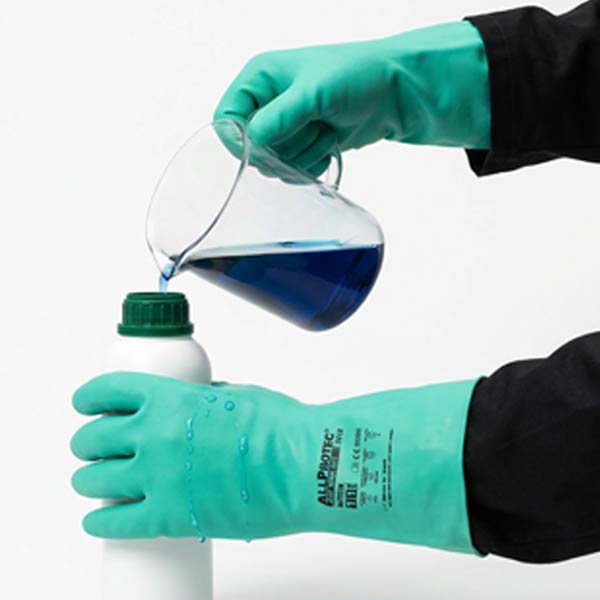
In addition, there are practical points that go beyond the standard: chemical protective gloves are checked for damage before each use, changed after contact with concentrate, and not reused after washing. And length matters: during decanting, liquid can run along the forearm – a short glove leaves this area unprotected.
Why standard labeling alone is not enough
A standard marking describes what has been proven under defined test conditions: specific test chemicals according to EN ISO 374-1, a pesticide surrogate, and minimum mechanical requirements according to ISO 18889:2019. It does not describe how the glove behaves towards a specific commercial product in its actual concentration, during real exposure time, and under the conditions of the respective activity.
Therefore, a G2 classification does not guarantee suitability for every arbitrary plant protection product. It sensibly narrows down the selection and shows that the glove is designed for handling concentrated agents. The final decision only comes from matching it with the safety data sheet, registration requirements, and manufacturer information – and in case of doubt, by contacting the glove manufacturer regarding the specific preparation.
A practical example: the Allprotec Nitrix 9513
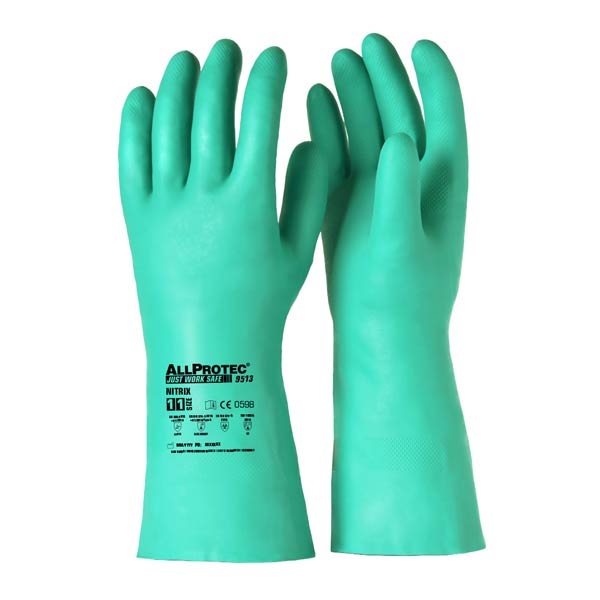
How the described markings come together in practice is shown by the Allprotec Nitrix 9513 – a nitrile chemical protection glove tested according to both standards.
| Property | Specification |
| Chemical Protection | EN ISO 374-1 Type A, Marking AJKLMNOPT (nine test chemicals passed) |
| Plant Protection | ISO 18889:2019, Class G2 |
| Mechanical Properties | EN 388, Performance Level 4101X |
| Material | Nitrile, latex-free |
| Wall Thickness | 0.38 mm |
| Length | 330 mm |
| Surface | Diamond finish for wet and dry grip |

>> ALLPROTEC® NITRIX WITH 31.8% DISCOUNT <<
The marking AJKLMNOPT stands for a particularly broad spectrum of chemicals within the EN ISO 374-1 test list. The G2 classification according to ISO 18889:2019 complements this with suitability for dilute and concentrated plant protection products as well as the minimum mechanical requirements of this class; performance level 4101X according to EN 388 separately indicates abrasion resistance.
In practice, the 330 mm length provides protection for the hand and forearm, for example when decanting from containers. The 0.38 mm wall thickness offers good tactile sensitivity and sufficient flexibility for typical tasks such as opening closures or operating valves. The diamond finish ensures a secure grip, even when containers are wet.
In addition to crop protection, such a glove is used wherever chemical protection is required – for example in cleaning and disinfection work or in laboratories and industry. Here too: The actual suitability depends on the chemical, concentration, exposure time and activity and must be checked using the manufacturer's information.
Result
ISO 18889:2019 closes a gap left by conventional chemical testing: It evaluates protective gloves specifically for handling plant protection products. G1 stands for lower-risk applications and excludes concentrated products. G2 offers the higher level of protection for diluted and concentrated plant protection products and also sets minimum mechanical requirements – which is why G2 is particularly relevant when preparing, mixing and filling.
The labeling is the entry point into the selection, not its end. The safety data sheet, approval conditions, the specific formulation, concentration, exposure time, and activity help determine whether a glove is suitable for a particular product. Anyone who reads these points together with the G1/G2 labeling makes a much safer decision.
If you want to experience the Allprotec Nitrix 9513 for yourself, you can test it at a special price in November. Up to 12 pairs per size can be ordered per customer at the promotional price.
>> ALLPROTEC® NITRIX WITH 31.8% DISCOUNT <<
Test now: the November promotion
If you want to check whether the Nitrix fits your applications: In November, you can order up to 12 pairs per size at the promotional price and test them in your own facility – under real conditions and with your applications. Feel free to contact us – we will help you evaluate your use cases.
Putting Safety First – Your protection pros from AAV.
ISO 18889:2019 – G1 and G2 for protective gloves for plant protection products

Frequently Asked Questions
Which industries is the Allprotec® Nitrix 9513 suitable for?
As a Type A chemical protection glove, it is at home in cleaning and building services, laboratories, food processing, the chemical industry, agriculture, animal care, nurseries, horticulture and landscaping, as well as by contract service providers - an item for very different tasks, which simplifies procurement.
Which chemicals is the Nitrix tested against?
According to EN ISO 374-1 Type A with the code AJKLMNOPT - i.e., against nine test chemicals: methanol, n-heptane, sodium hydroxide 40%, sulfuric acid 96%, nitric acid 65%, acetic acid 99%, ammonia water 25%, hydrogen peroxide 30%, and formaldehyde 37%. For specific use, the breakthrough times in the data sheet and the safety data sheet of the medium are decisive.
What is ISO 18889?
A standard that describes requirements for protective gloves specifically for handling plant protection products. It tests against practical formulations rather than pure substances and classifies gloves into performance categories G1 and G2.
What is the difference between G1 and G2?
G1 stands for handling ready-to-use, already diluted products, such as during application. G2 additionally covers handling concentrates – opening containers, measuring, decanting, filling the sprayer – meaning the work steps with the highest exposure.
Why is the G2 category especially important in autumn?
With the sowing of winter cereals and oilseed rape, September and October mark the peak season for autumn treatments – herbicides against grass weeds such as black-grass and silky windgrass, measures in young oilseed rape, and more. Each of these applications starts at the mixing station with concentrates – exactly the area of application that G2 stands for.
How long am I allowed to use a chemical protective glove?
Chemical protective gloves are not a seasonal item: check for damage before every use, change after contact with concentrate, and do not continue to use used gloves after washing.
Why is glove length important in crop protection?
When decanting, liquid runs down the forearm – a short glove offers insufficient protection there. Models with a length of 330 mm such as the Allprotec® Nitrix 9513 protect the hand and forearm without an additional cuff.