
How to choose the right safety shoes for your employees
Safety shoes are more than just toe protection – they are a daily companion that combines protection, comfort and motivation. Whether it's a construction site, warehouse or workshop: the right selection prevents injuries, supports ergonomic working and reduces downtime.
Step 1: Risk assessment – the starting point for safe shoes
Before you choose a model, you need to know where and how the shoes will be worn. The risk assessment provides the basis for this. It takes into account mechanical risks such as bumping, slipping or stepping through and should ideally be carried out together with an occupational safety specialist.
| Application area | Typical risks | Recommended protection class |
| Construction & Crafts | Heavy materials, nails, rubble | S3 or S5 – puncture-resistant, robust, profiled outsole |
| Electrical & Assembly | Risk of slipping, contact with metal, work on electrical installations | S2 or S3 – anti-slip, antistatic, ESD if necessary |
| Warehousing & Logistics | Wet or oily floors | S1P or S3 – non-slip, shock-absorbing, ergonomic |
| Gardening & Landscaping / DIY | Moisture, dirt, sharp objects | S2 (water-repellent) or S3 (for higher risk of penetration) |
| Electrical industry / test areas | Sensors, sensitive electronics | Metal-free models – avoid interference signals |
If you work with chemicals or heat, you need additional standards, e.g. EN 13832 (chemical protection) or EN ISO 20349 (heat protection).
Step 2: Selection according to application area and standard requirements
EN ISO 20345:2022 brings more clarity to the selection of safety shoes. The new waterproof classes are particularly important:
- S6 = S2 + WR (waterproof, without penetration protection)
- S7 = S3 + WR (waterproof, with penetration protection)
At the same time, the 2011 version remains valid as long as the type examination passes. The following criteria help with the selection:
- Protection class (S1 – S7)
- Sole material and profile (rubber, PU, TPU)
- Upper material (leather, textile, microfiber)
- Permissible orthopaedic adjustments (DGUV 112-191)
- Fit and width
Practical tip: Even small companies can take a pragmatic approach. It is important that the models chosen fit the risk assessment – even if employees procure their shoes themselves.
Step 3: Comfort & fit – consider orthopaedic adjustments
A safety shoe only protects when it is worn. That's why comfort is a key factor. Wearing tests with employees help to evaluate fit and ergonomics. Also note:
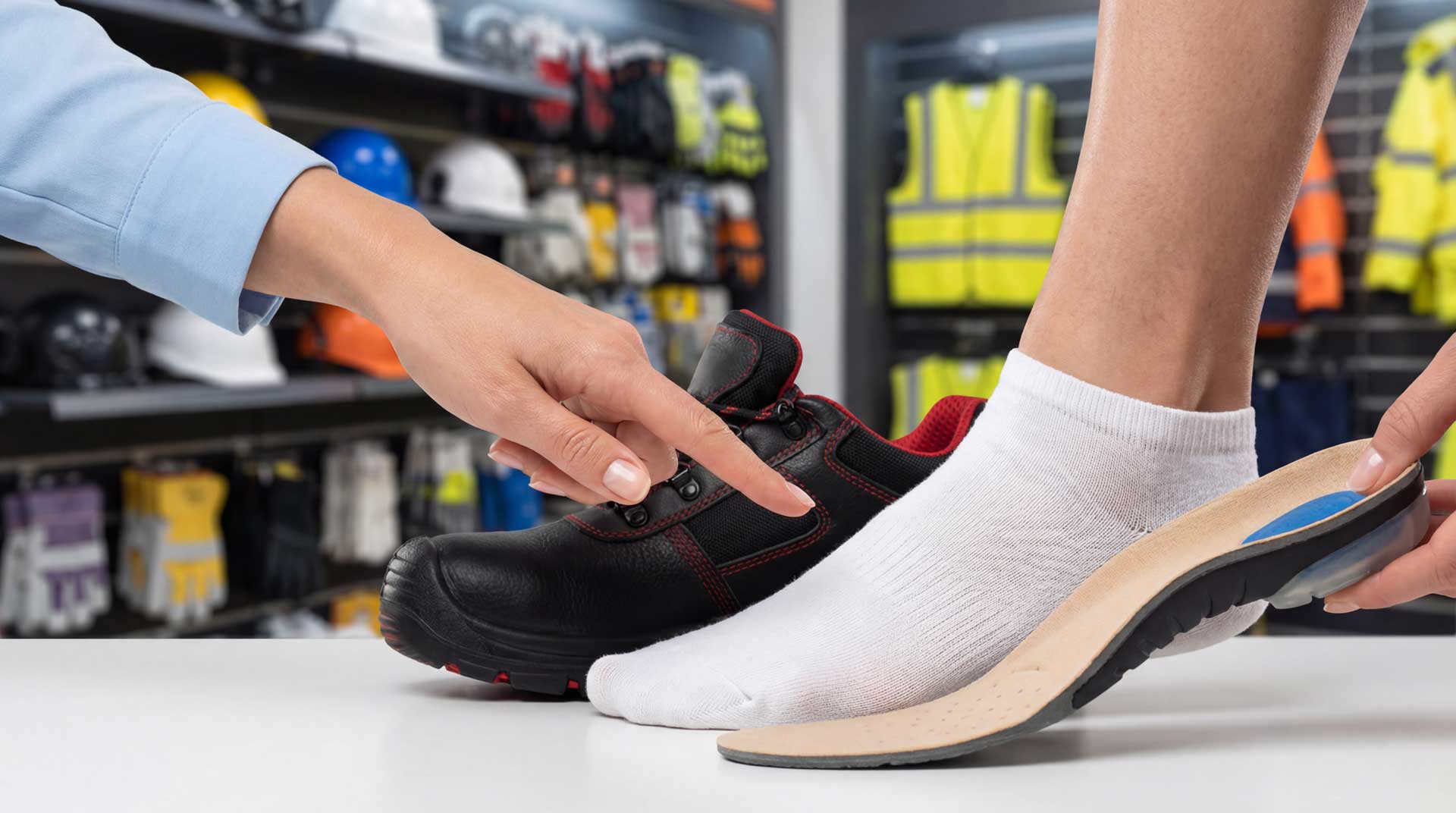
- Use orthopaedic insoles only if approved in accordance with DGUV 112-191
- Wide models for lowering, spreading or hallux problems
- Digital fit tools or size guides from manufacturers
Step 4: Service life, repair & sustainability
High-quality safety shoes are more durable and sustainable. You should pay attention to this:
- Robust materials and replaceable insoles
- Repairs only by certified specialist companies
- Use of durable and recycled materials by many manufacturers
Tip: Drying shoes at room temperature and airing them regularly – this protects materials and membranes.
Step 5: Cost/benefit – think long-term
Cheap models seem tempting, but often cost more in the long run. High-quality safety shoes improve safety, comfort and health. This pays off through:
- Fewer injuries and lost days
- Higher acceptance and daily wearing
- Longer service life and lower follow-up costs
- Better cushioning and ergonomics for long working days
Result
The right safety shoes not only protect your feet, but also your health, motivation and budget. Those who pay attention to standards, areas of application, comfort and quality create sustainable safety in everyday work – step by step.
Protect yourself. Love you.