
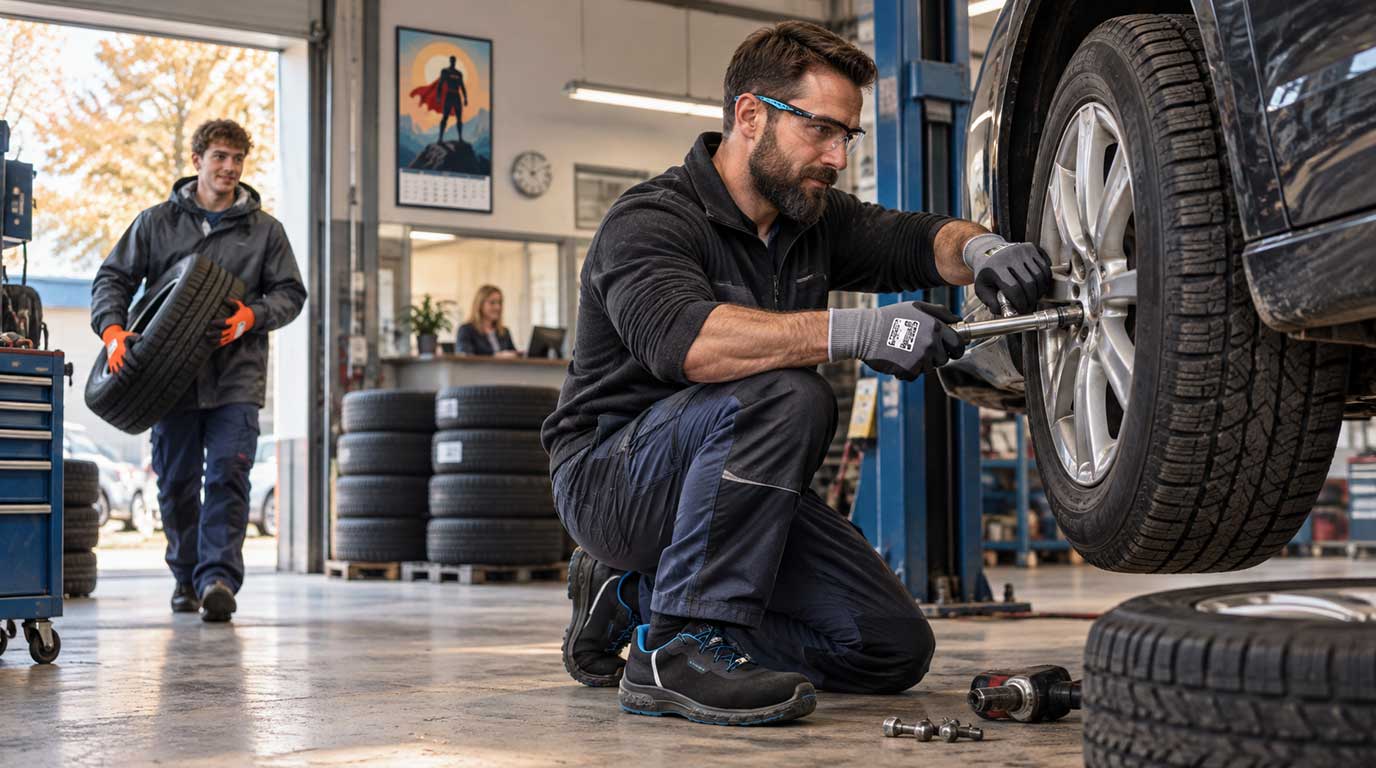

October is tire change time. Everything is running at full speed in the car workshops now – inside on the lift, outside in the yard, in all weather. Time to focus on the people who ensure everyone else can keep moving safely. And who best know what they need for their hands, feet, and eyes.
Anyone who gets an appointment for a tire change in October is lucky. The phone rings every minute, wheel sets are piled up in the yard, and somewhere between lift two and the balancing machine, the 10mm socket has disappeared again. Workshop heroes don't wear capes – they would only get caught in the impact wrench anyway. Their superpower is less spectacular and much more useful: they tighten every wheel bolt with the correct torque. Again and again. Day after day.
The tire change is just the most visible part of the work. Brakes, exhaust, suspension, inspection, breakdown vehicle in the yard – workshop life has many situations. And those who are in it every day quickly realize: It takes more than just good tools. It takes equipment that fits your own work – not what happens to be hanging in the locker.
Standing safely: eight hours on concrete
A complete wheel slips out of your hand faster than the October calendar allows. Add to that a workshop floor that is rarely just dry: a drop of oil here, some brake cleaner there, moisture from vehicles that have just driven in from the rain.
An S3 safety shoe like the Lemaitre Michel Low S3 SRC ESD (Art. 6205) offers important protective features for this: toe cap, penetration-resistant sole, and an outsole with tested slip resistance. The extra-wide fit is not a minor aspect, but for many the actual purchasing decision – those who stand, kneel, and get up on concrete all day notice every millimeter. A shoe that pinches won't be worn. One that fits will never be given up.
Grip securely: Tactile feel with grip
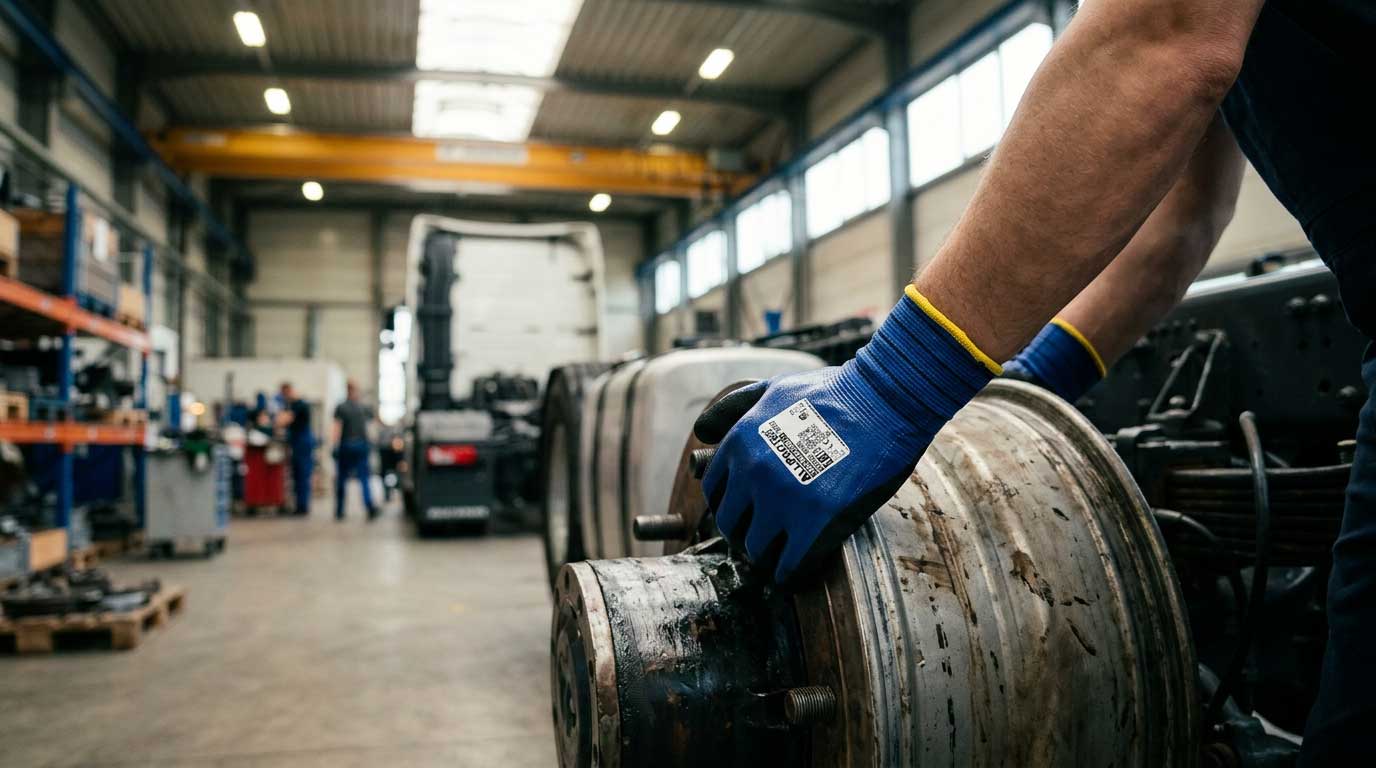
Wheel bolts, valve caps, clamps, clips: In the workshop, you rarely grab roughly and almost always grab precisely. The assembly glove Allprotec® Eclipse (Art. 9508) is built for this – a fine 15-gauge knit of nylon and spandex that fits like a second skin, with a microporous nitrile coating on the palm. This ensures a secure grip, even when surfaces are slightly oily, while the uncoated back of the hand can breathe. The glove is tested according to EN 388 against mechanical risks.
Honestly, it takes courage: Gloves have no place on rotating parts – even heroes know their limits.
Protect your eyes: what lurks under the car
Anyone who has ever stood under an older vehicle knows: rust and other particles can come loose when working on the underbody. Add to that brake dust, wire brushes, and compressed air.
The Bollé RUSH+ 2.0 (Art. 1272) is a lightweight protective goggle that you forget about after five minutes – and that’s precisely the point, because goggles that bother you end up on your forehead instead of in front of your eyes. Its PLATINUM coating prevents fogging and scratches on both sides of the lens. Practical in October, when you move from the cold yard into the warm hall and still need clear vision.
Workwear: ten pockets and a place for your knee
Changing tires also means: down on your knee, up again, next wheel. Four times per car, dozens of cars a day. The Planam Plaline Work Pants (Art. 1981PL) made of durable canvas blend fabric features knee pockets for matching knee pads, an elastic waistband for a good fit, and ten pockets – increasing the chances that the 10mm socket will turn up again this time. Reflective piping ensures you are seen in the dim yard.
Stay warm: when the rim is colder than your mood
The wheels are rarely stored in a warm place. Anyone who retrieves the first sets from the container or the yard in the morning reaches into cold metal. The Allprotec® Winterhandschuh Arctic (Art. 9528) combines a warming acrylic knit with a grippy latex coating and is tested according to EN 511 for protection against contact cold – exactly for the moment when the hand touches a cold workpiece. This keeps hands protected even when working with cold parts.
Staying dry: the yard has no roof
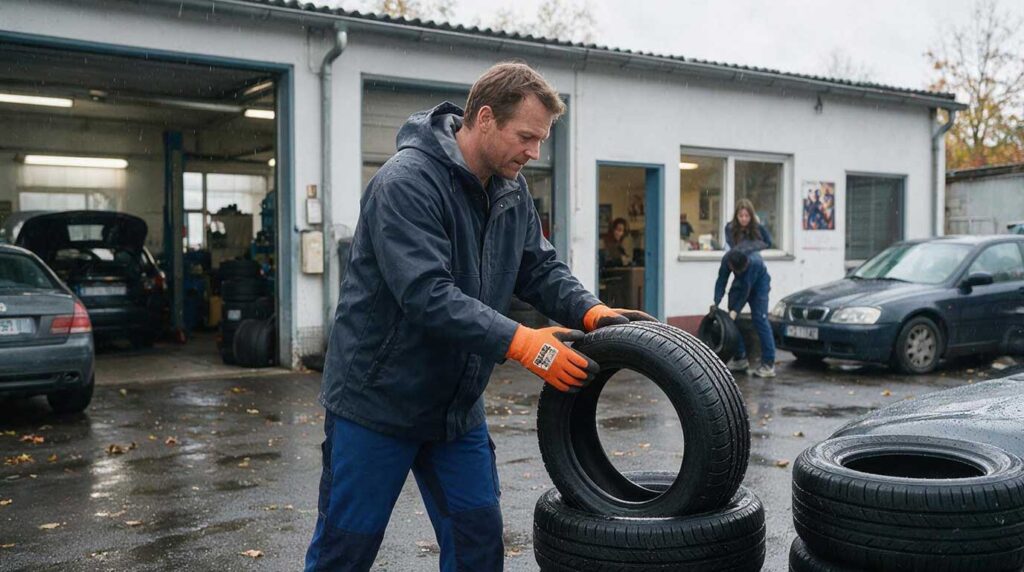
Reparking vehicles, loading wheels, taking a look at the broken-down car in front of the door: Part of the workshop work takes place outside, and October doesn't take that into account. The Portwest Sealtex Ocean Regenjacke (Art. 23601) is waterproof, has taped seams, a double storm flap and a hood with a peak. The material is soft and flexible and can be easily wiped clean if necessary.
Workshop heroes also exist in the garage next door
Not every workshop hero has a car lift. Some have a jack, two axle stands and a Saturday morning. Anyone who fits the winter wheels on their own car themselves, changes the brake pads or gets the classic car through the winter works under conditions similar to the pros - only often with less space, less light and the garage door as the only protection against the weather.
Even when working on things in your own garage, slippery floors, falling parts as well as cold or oily parts can become an issue. That is precisely where the right equipment pays off: a shoe that does not slip on the garage floor when the wheel bolt is stuck. Glasses when the wire brush goes over the brake disc. Gloves that grip even on cold rims. Because the difference between a professional and a hobby mechanic lies primarily in the routine.
Six situations, six answers
None of these six parts were invented for changing tires, and together they are not a complete package that equips a workshop from head to toe. Rather, each of them addresses a situation that occurs again and again in everyday workshop life – in October and the months that follow: standing securely, gripping securely, seeing clearly, being well-dressed, staying warm and dry. Your own workplace decides which of these is needed. And anyone who stands in it every day knows best.
In October, all six items are part of the Deal of the month at Omniprotect – found at www.omniprotect.de. A small token of appreciation for everyone who ensures that the rest of the country rolls safely through autumn. Whether in the workshop or in your own garage.
Frequently Asked Questions
Which safety shoes are suitable for the car workshop?
S3 safety shoes can be a suitable choice for activities in a car repair shop. Among other things, they offer toe protection, penetration resistance, and a slip-resistant outsole. Which protection class is required depends on the specific activities and hazards.
Are assembly gloves also useful when dealing with oily parts?
Gloves with a microporous nitrile coating, such as the Allprotec® Eclipse, provide good grip on slightly oily surfaces. For heavily oil-soaked work or handling chemicals, other glove types are intended.
What does EN 511 stand for in winter gloves?
The standard describes protection against cold. The Allprotec® Arctic is tested for contact cold – meaning for touching cold objects. It is not waterproof. The coating contains natural latex, which must be considered in case of a latex allergy.
Is protective equipment also worthwhile for hobby mechanics?
Yes. Even when working in your own garage, slippery floors, falling parts, as well as cold or oily parts can become an issue. All items are also available individually and in small quantities at Omniprotect.
Are the items only intended for changing tires?
No. Changing tires is the occasion, but the equipment belongs to the entire workshop routine – from inspections to outdoor work.