


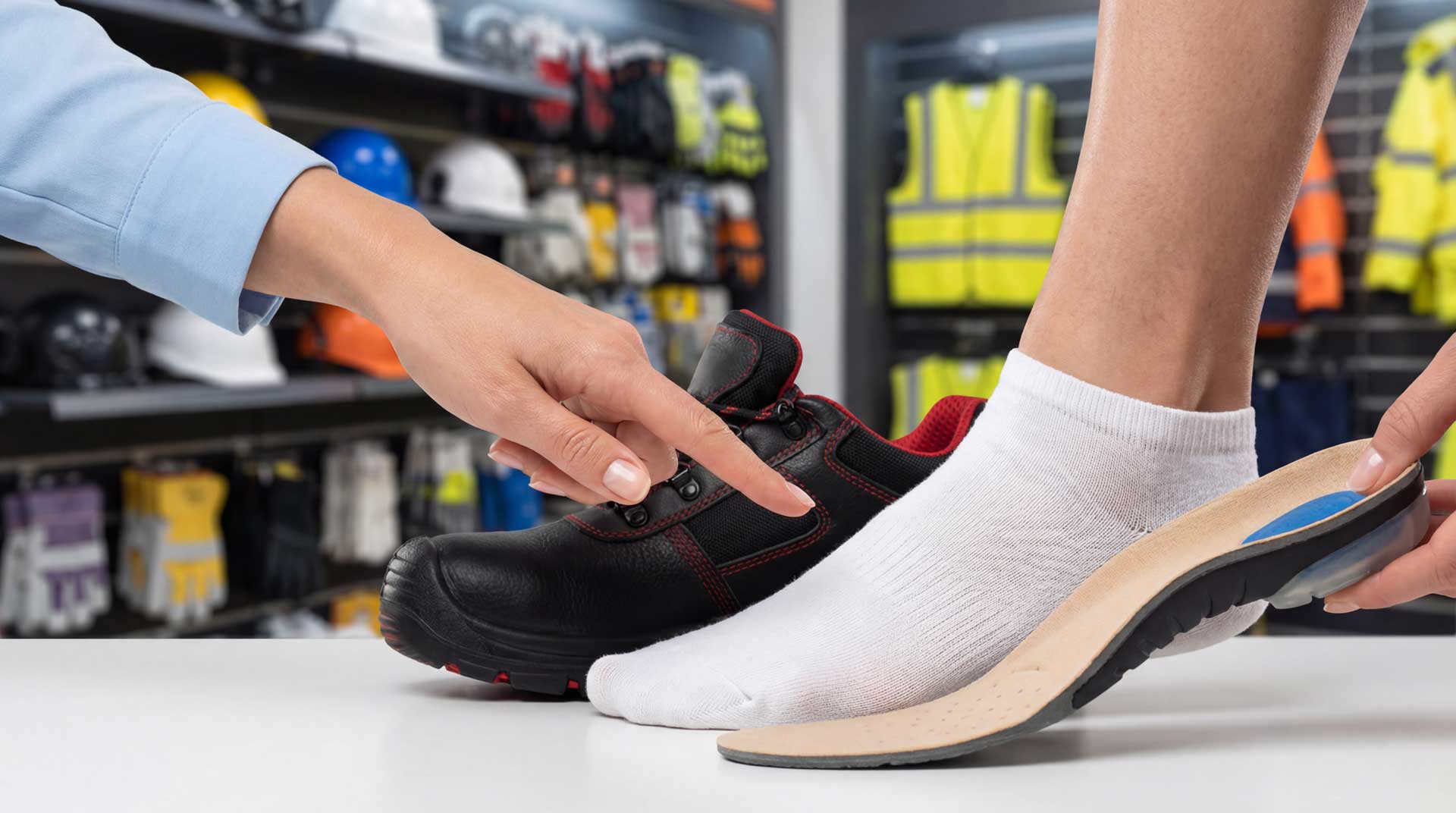
Nowadays, many safety shoes are marked with the yellow logo for ESD shoes, but only a few know the meaning of this marking and what it entails. It is also interesting to see how visitors can be easily equipped with ESD safety shoes so that they can visit the production facility safely. In this article, the protection professionals explain what the ESD standard is all about and how it can be implemented in a practical way.
The abbreviation ESD and what is behind the term
The abbreviation ESD stands for "Electro Static Discharge". ESD refers to the moment of equipotential bonding between two differently electrostatically charged bodies. Here's a simple example: If someone walks over a carpeted floor and then touches a metal door handle, a small electrostatic voltage is exchanged. The friction of the safety shoe sole over the carpet creates an electronic voltage that cannot be dissipated by the safety shoe. For humans, this electronic discharge is not dangerous or harmful. However, the voltage, which people usually do not even notice, can damage or even break sensitive electronic components such as microchips. In addition, when working with flammable substances or vapours, there is a risk of ignition by sparks. When working with components or highly flammable substances that are sensitive to electrostatic discharges, ESD safety shoes must be worn, among other things.
What are ESD safety shoes?
Safety shoes and work shoes are marked with the ESD pictogram if they are certified according to the EN 61340-5-1 standard. Safety shoes with ESD equipment have an electrical contact resistance of the "person-shoe-floor" system. This must be in the range greater than 10 5Ohms (100kOhm) and less 10 9ohms (1,000 MOhm), which reduces an electrical charge by dissipating the charges.
"However, charging can be affected by many different factors. The degree of contamination and the climate (humidity and temperature) can significantly change the electrical resistance."
The safety professionals therefore recommend that an on-site test of the electrical resistance be carried out regularly so that the conductivity of the ESD safety shoes is guaranteed. It is important to know that safety shoes with ESD equipment are not suitable for electricians or people who work on sources with electrical voltage.
Where are ESD safety shoes worn?
Electronic components are used more and more often and are a constant companion in our daily lives. We find them in cars, navigation systems and ABS, as well as smartphones and many other practical electronic aids in everyday work and in the household. In the manufacture of such products, attention must be paid to the integrity of the sensitive electronic components, otherwise a defective product will be manufactured. ESD safety shoes are therefore absolutely necessary when working with magnetic data carriers or electronic components, such as in research institutions, industry or manufacturing.
Visitor shoes with ESD equipment
In areas where safety shoes with ESD equipment are mandatory, visitors or employees from the office must also be equipped with appropriate footwear. For hygienic and cost reasons, overshoes are often used for these visitor groups. These visitor shoes can be easily put on over your own street shoes and can therefore be used by different people.
In addition to the protective properties of the steel toe cap and the puncture-resistant sole, the Millenium Full Protect model from the French manufacturer Gaston Mille also meets the EN 61340-5-1 standard (ESD capability). With this visitor shoe cover, not only the visitors, but also the components are well protected.
Sudden safety thanks to ESD safety shoes
It is important to know that the sudden safety of ESD safety shoes refers to sensitive objects and not to the wearer himself. The wearer of ESD safety shoes should continue to deal with occupational health and safety measures in order to avoid accidents at work. Helpful tips and tricks on occupational safety can be found in other articles on the blog of the protection professionals.