
Comfort, protection and compliance – what has changed with the new EN ISO 20345:2022
When it comes to safety shoes, many people first think of toe protection or non-slip soles – but what if your feet just don't fit into the standard shoes?
Squeezing toes, metatarsal pain or knee problems are no small thing – they can endanger your health in the long term. Especially in the case of flat feet, splayfoot or hallux valgus, you quickly notice that normal safety shoes are not enough.
This is where orthopaedically adapted safety shoes come into play – individually manufactured or adapted, always standard-tested and increasingly available in extra-wide fits.
Why standard safety shoes are often not enough
"Off-the-shelf" safety shoes are designed for the average foot – but no foot is really average.
Anyone who needs misalignments or orthopaedic insoles knows the problem: pressure points, uneven loading, pain.
Some describe it as a slight "tilting" when standing or walking – a poor posture that can cause knee, hip or back problems in the long term.
Conclusion from practice: An incorrectly fitting safety shoe does not protect – it can become a risk itself.
DGUV 112-191: The standards check for orthopaedic safety shoes
DGUV rule 112-191 ensures that orthopaedically adapted shoes retain full protection even after modifications – including:
- Toe protection
- Penetration resistance
- Slip resistance
- Electrical conductivity
But: You must not use private insoles from everyday life in safety shoes!
Even small differences in height between the footbed and the toe cap can change the protective space - in an emergency, there is a risk of injury.
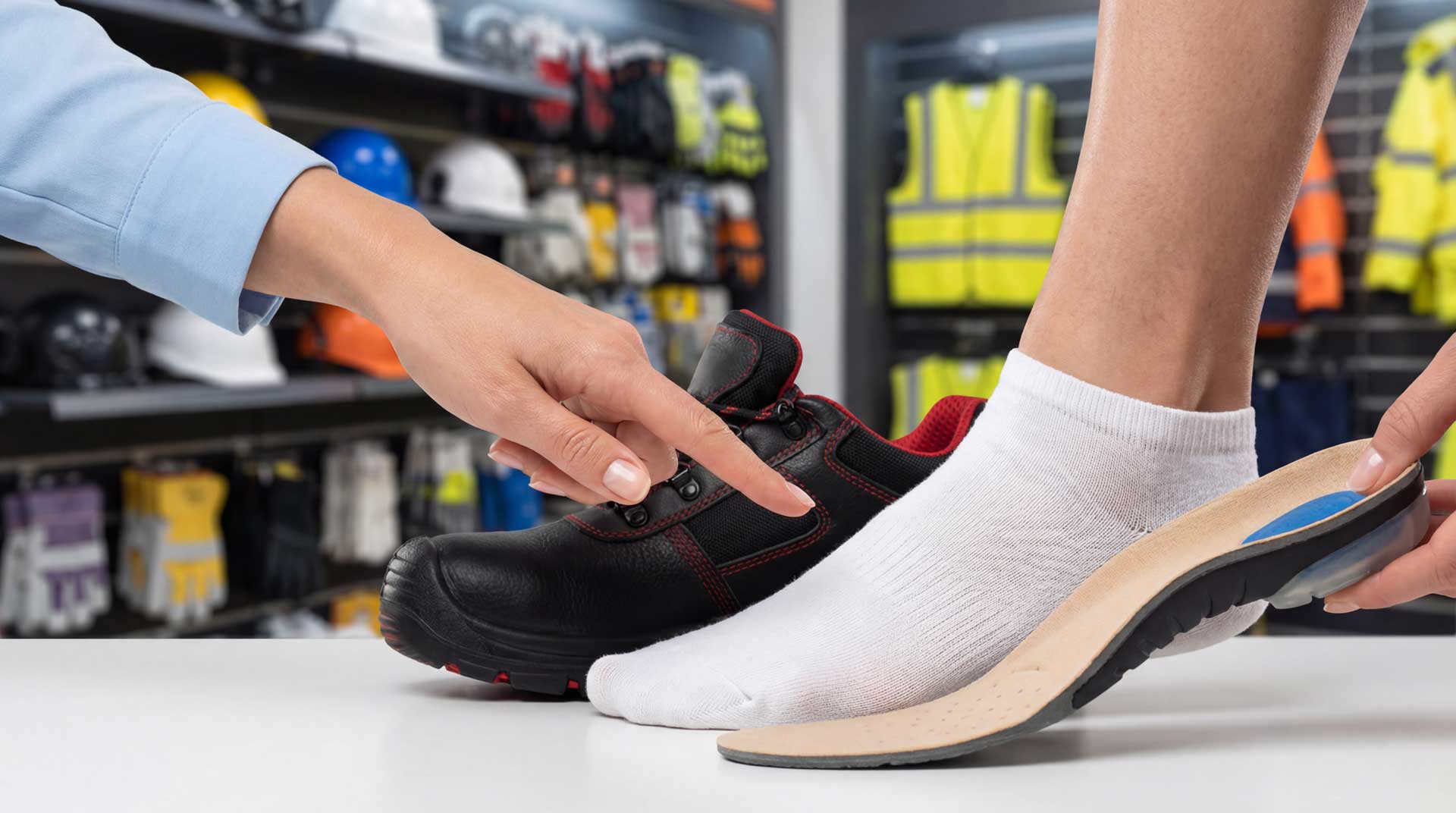
Only tested insoles or adjustments by certified specialist companies are permitted.
How orthopedic adjustments work
There are three approved variants of how safety shoes can be adapted:
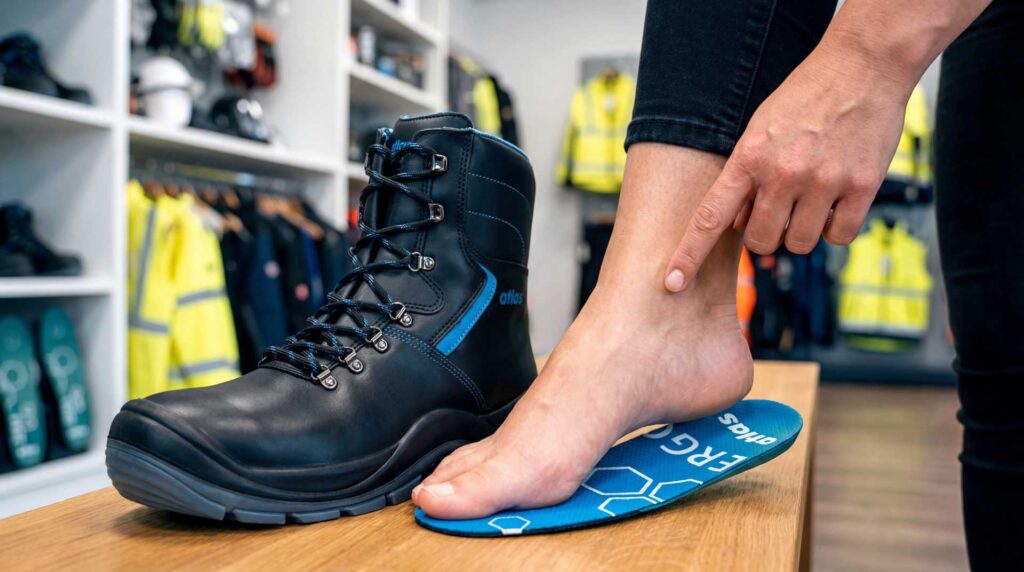
- Tested insoles (type 1)Tested insoles are specially adapted to the shoe model and ensure comfort and standard protection.
- Standard insoles from the manufacturer – with slight adjustments such as cushioning or support function (not glued tightly).
- Individual insoles that are custom-made by the orthopaedic shoemaker and are permanently integrated into the shoe.
- Dressed safety shoes (type 2)Specialist companies modify existing models, e.g. by padding, stretching or reinforcing.
- Custom-made safety shoes (type 3)Completely custom-made models – ideal for complex foot shapes or medical requirements.
Orthopaedic adaptations in the new EN ISO 20345:2022
New in the EN ISO 20345:2022 standard include:
- The explicit classification of orthopaedically adapted safety shoes into three types: insole solution (type 1), direction of tension on the shoe (e.g. stretching, padding, fixations)" i (type 2) and customisation (type 3).
- A clearer stipulation that the usual protection requirements – such as toe protection, penetration protection, slip resistance – must be retained for such special models.
- Associated with this: more transparency as to which protection and testing criteria apply to orthopaedic models.
Important: Whether a complete retest is required for a specific adjustment still depends on the respective model, test method and manufacturer.
The aim of the standard is to better ensure compliance with the standard, even in the case of individual adaptations – for more safety and clarity in practice.
Who bears the costs?
Financing depends on who uses the shoe and why:
| Situation | Assumption of costs by | Note |
| Safety shoes are mandatory in the company | Employers | Adaptation is considered part of protective equipment |
| Medical necessity (e.g. hallux valgus) | Health insurance / pension insurance / employers' liability insurance association | Medical certificate required |
| Private purchase without prescription | Self-payer | Advice from a specialist company recommended |
Tip: Precise documentation of the fitting and a cost estimate from the specialist company make reimbursement easier.
Advantages in everyday work
Orthopaedically adapted safety shoes offer more than just protection:
- Less foot and joint pain
- Better posture & balance
- Reduced fatigue during long working days
- Standard-compliant protection for individual needs
- Wide fits & flexible adjustments
You can find more on the topic in the blog post:
"Understanding safety shoes – that's what S1 to S7 mean"
Practical example from industry
- A warehouse worker with splayfoot complained of pain despite new safety shoes.
- After an orthopaedic adjustment (type 1: tested insole), he now works pain-free.
- The shoe retained its EN ISO 20345 certification, as the adaptation did not affect the safety-related properties.
- The result: better ergonomics, higher wearing acceptance and fewer sick days.
- The BG takes over only in the case of work-related foot problems . For purely private problems, rather GKV / DRV.
Conclusion – Protect yourself. Love you.
Safety doesn't end with the toe cap.
Orthopaedically adapted safety shoes combine protection, comfort and health - so that you feel safe and comfortable at work.
When standard models pinch or hurt, an orthopedic solution is not an option, but a gain for your well-being.
Get advice from a certified specialist company - because only shoes that really fit really protect you.
Protect yourself. Love you.