
It's about losses and about saved suffering and money saved. After all, there is a shortage of skilled workers everywhere, but companies earn their money with their work. Every company should protect its hard-working human capital out of self-interest and protect it from accident and death.
Unfortunately, this is not the case, because there is a lack of communication. The sense of danger. I run away from a dino. Not before work! The danger is more abstract and is not (anymore) recognized. The everyday is underestimated. You don't talk about things that are taken for granted. That's why people are no longer aware of the danger.
💁 My protection professional tip!
Rely on communication and education. Occupational health and safety saves money!
💁 How do I come up with that? Through practice or in this case a seminar.
There are also more and more digital solutions for communication and training. New data and product information have been submitted by the brand manufacturer Honeywell on the subject of welding protective clothing. That was good and convinced with numbers. An important piece of information was that 3% of all welding accidents are unavoidable, so-called "force majeure". The rest of the company is homemade. The so-called "human" factor.
"In 97% of all welding accidents in 2020, the applicable safety rules were circumvented or disregarded. Only 3% of accidents during welding were caused by the welding industry. Employers' Liability Insurance Institution for Wood and Metal (BGHM) in the category of force majeure."
Conclusion: 97% of accidents are avoidable. In plain language, this means that there is money on the street that is lost! That's why I really wanted to link this information. Unfortunately, I couldn't find the numbers at the BGHM. Even a mentioned annual report from 2020 did not statistically provide these figures. What a pity!
But when it comes to life and limb or the financial future of people and companies, figures should be concrete and correct. That's why I used the Employers' Liability Insurance Institution for Wood and Metal (BGHM) Demand. Thank you – For the friendly support from the Communication & Rights Management department and every nice person who played a part in it. 😄
💁 Facts and figures – data
Only the figures were neither refuted nor confirmed by the BGHM. The questioning methods did not allow the conclusions to be drawn. Instead, I was given a freely accessible publication (Source: BGRCI) from 2014. Not much has changed since then. On page 5 (the small digits) there is a pie chart and a ratio of 90% to 10%. This is nicely called: "Causes of events and losses. In other words, causes of accidents". The 90% of the causes of accidents include inefficient control, unclear responsibility, poor process planning and a lack of employee involvement.
So lack of communication!
Only 10% of accidents are of a technical nature, outside the possibilities of communication. To put it another way, we call it force majeure. According to my interpretation and roughly translated, 90% savings are also a lot.
💁 My protection professional tip!
- Create a qualified hazard analysis of the workplace/work
- Involve your employees and educate them through transparent process planning and regular instruction
- Create clear responsibilities and structures
- Effectively control compliance with work regulations and the correct use of personal protective equipment
Personal Protective Equipment (PPE) in Practice
This is a practical example. So that it is clear what I mean when I speak of the lack of sense of danger. This conversation really happened and it does not describe an isolated case. Anonymized and retold for data protection reasons. (M for employee and A for caller)
The glove is always to blame
Ring... Ring... the phone rings...
To welcome...
A: Hello, your leather gloves are shit!
M: ??? Why?
A: Our welder tested them.
M: How?
A: He held his hands in the flame during acetylene welding.
M: ??? Oh, I see! They're joking! Roaring laughter! It's good ... with leather gloves in a 3000 °C hot flame...
A: That's no joke!
M: Stunned... Magma has about 1200 °C, the sun's surface around 5000 °C,
an acetylene flame ... Are you serious?
A: Yes! The gloves suck and don't keep the heat out.
M: Stunned... over 3000 °C ... and he touches the flame...
A: Yes! I complain about the gloves! We are now in trouble with the employers' liability insurance association...
What does personal protective equipment (PPE) do?
Find the mistake... What do you think, was the complaint recognized? In this heat, you can roast an elephant on a spit without turning it over. It is crispy on both sides. But first things first, the hands are still on. At these temperatures, this is not a matter of course. How do you come up with such ideas? Forgot the stove of your childhood? After all, leather is just a tanned skin.
It's like fishing fries straight out of the deep fryer with your bare hands. Ideally, frying oil has a temperature of "only" below 180 °C.
The crux of the matter is that neither the welder nor the caller are aware of the danger, or know what the PPE does and how to use hand protection. Neither of them came up with the idea that a "test" with a flame over 3000 °C is dangerous. They simply feel betrayed and disappointed. A product promise was not kept and they are now in trouble. Now the glove is to blame.
Stop... lousy quality.
💁 My protection professional tip!
Please ask before the "test"! Whether the glove is suitable.
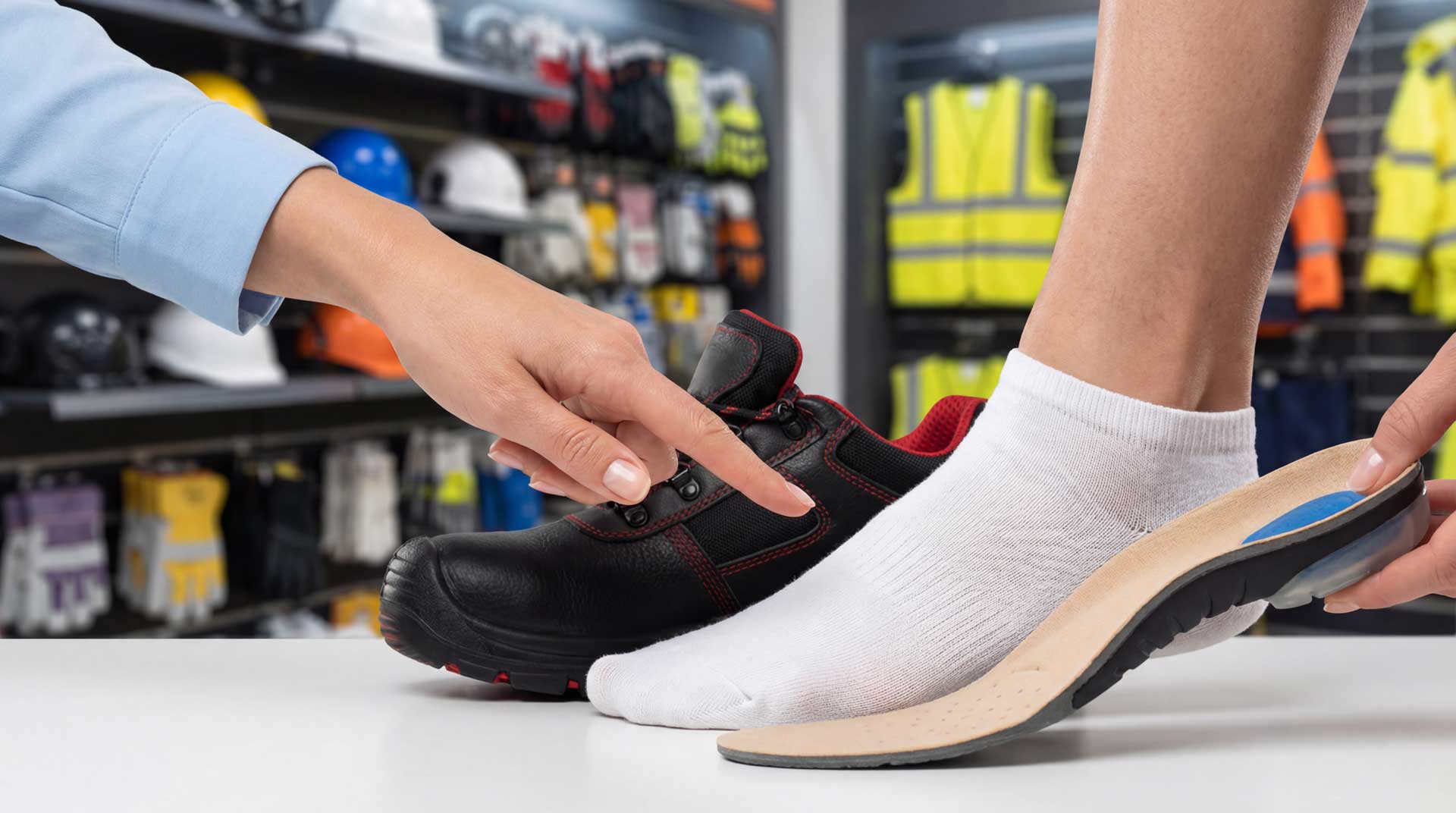
But even gentle hints are often ignored. For example, that insoles for work shoes require a corresponding certificate. No, it is then said that I am a grown man, I decide what I wear in my shoes . I could also report something similar about a test with cut-resistant gloves... also a self-test. It was also said that no, it would be better not to do it – too late.
Answer: "Yes, but ... don't worry! That's not a problem for these gloves."
… Again the most important thing, the fingers are still on, even if it was close.
To be clear, while trust is important, Personal Protective Gear does not give Jedi powers or make them immortal. Nor does she level them up for a walk in glowing magma. That's not what PSA is for. It serves the safety of people in a precisely defined dangerous situation. Dry and dirty here Information on the Personal protective equipment . Clear and factual – then it also works with PPE.
