


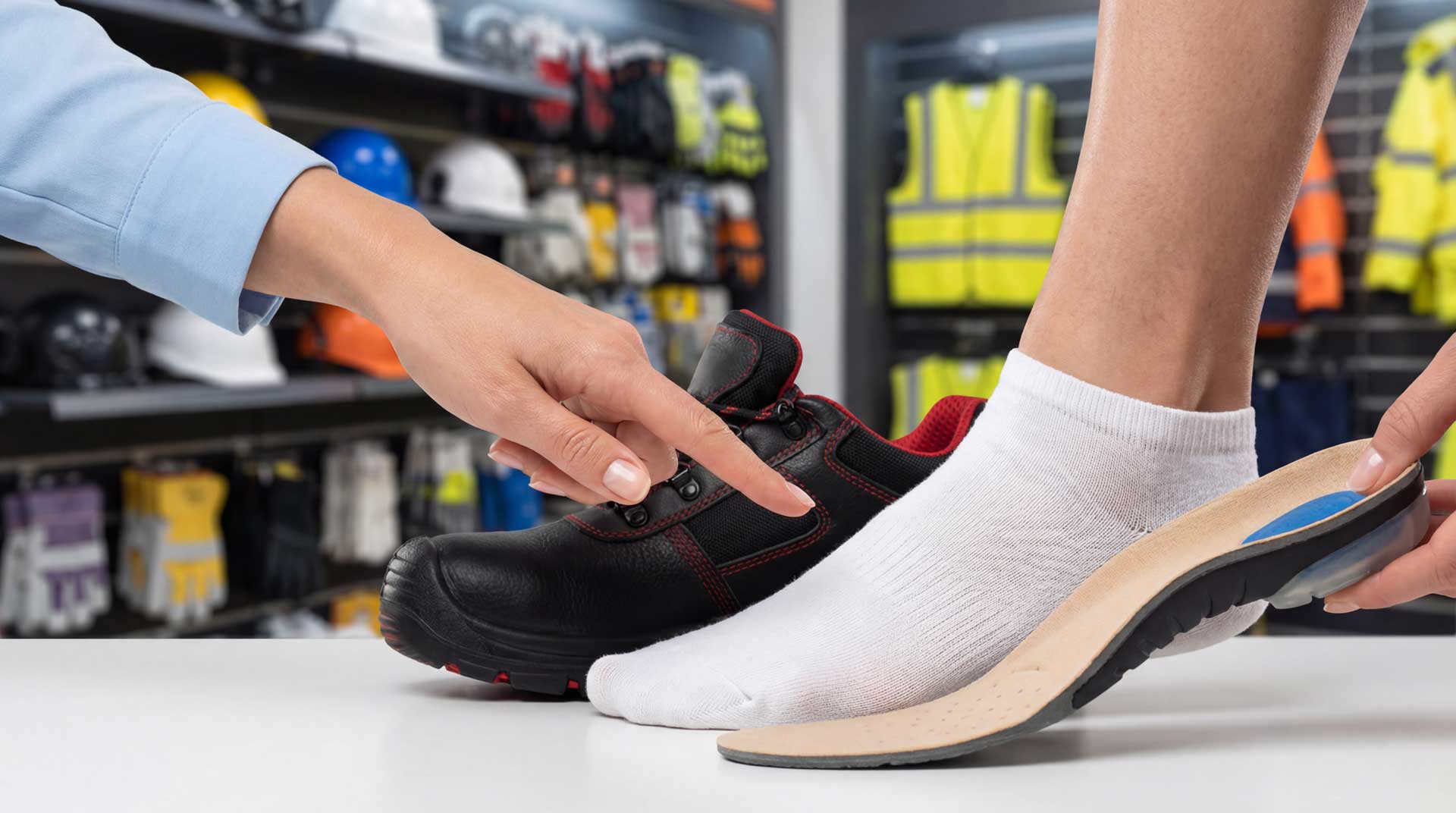
Safety shoes are worn for 8 hours or more per day. These must protect the wearer from various dangers even under the most difficult conditions.
The right width is important
For this, it is imperative that the shoe fits really well and is comfortable. What should be considered when choosing the size of a safety shoe? As a rule, safety shoes should be bought in the same size as normal street shoes. The existing protective cap in the safety shoes has already been taken into account in the fit and shoe size, so that no larger size is necessary.
Shoes that are too big are not good
Shoes that are too large do not fit properly, are uncomfortable and can also lead to (work) accidents! However, there are several factors that can be considered when choosing the right size. In the case of safety shoes, not only the length of the shoe is indicated, but also the width. The width of the work shoes is given in Mondopoint. The Mondopoint system is an internationally comparable metric measurement system that takes into account foot length and width in millimeters.
Over 75% of people who have to wear safety shoes get along well with width 11.
Width 11 as standard width
In the meantime, however, width 11 is not always sufficient and other models have to be used. If you have wider feet, or a flat or flat foot, you will need more space in the front of the shoe. Some manufacturers therefore already offer modern safety shoes up to width 14. These different widths are measured at the widest part of the foot. The circumference of the foot in the area between the metatarsophalangeal joint of the big and small toe is determined.
Distance differences are decisive
The difference in circumference between a width of 11 and a width of 12 is about 3 millimeters. Unfortunately, the specification of the widths is not uniform among the different manufacturers. Many manufacturers specify the widths in 10 / 11 / 12. Other manufacturers distinguish between L and XXL, wide and extra-wide, or S / M / L.